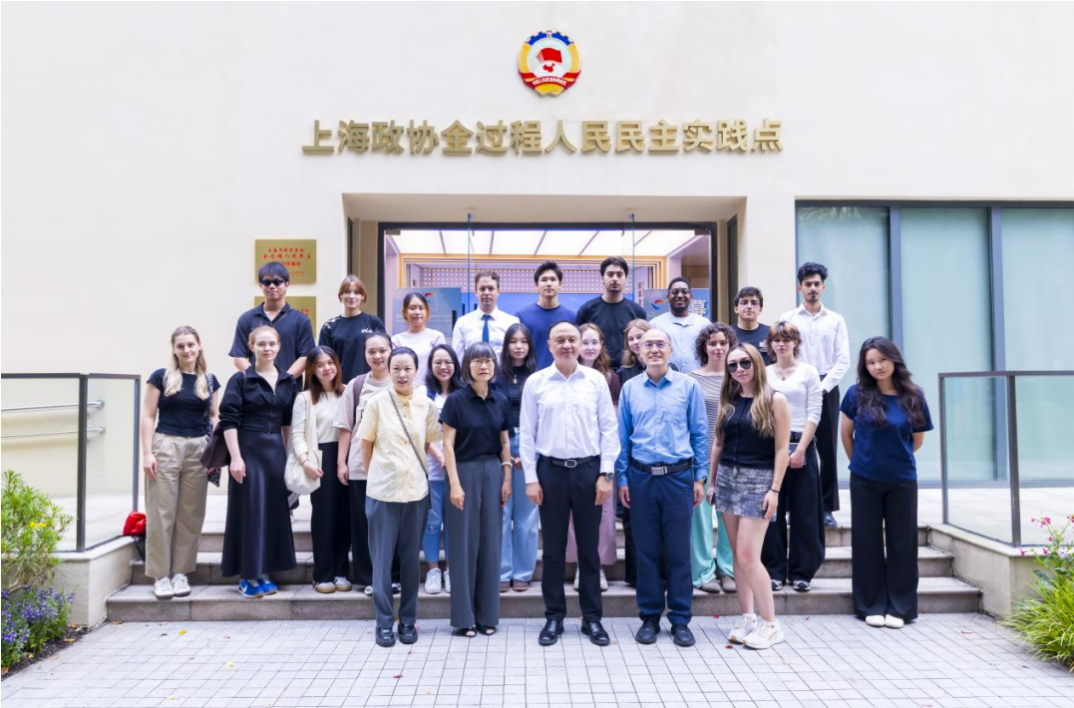
From April 8 to April 10, Shanghai Court's Practical Experts Group Tour Lecture Series kicked off at Shanghai University of Finance and Economics. Judges, prosecutors, lawyers from the fields of judicial practice and legal theory joined the university's faculty and students for classes, sparking collisions and dialogues between judicial practice and academia.

Afternoon of April 8th, the series of lectures was inaugurated at the first - floor auditorium of the Entrepreneurship Center on Wuchuan Road Campus of Shanghai University of Finance and Economics (SUFE). The launch event was presided over by He Pengcheng, Deputy Secretary of the Party Committee and Discipline Inspection Secretary of SUFE.

Liu Yuanchun, President and Deputy Secretary of the Party Committee of SUFE, delivered a welcome speech. President Liu extended his warm welcome and sincere gratitude to the colleagues from the Shanghai judicial system. In today's era, characterized by the surging digital economy and rapid financial innovation, the deep integration of the rule of law and economic development has become an irreversible trend of the times. Faced with new situations and requirements, SUFE is committed to cultivating compound - type excellent financial and economic talents with a global vision and legal literacy. It is hoped that SUFE students will not only be the trendsetters of the market economy in the new era but also the builders of a law - based society. The university also looks forward to using this lecture series as an opportunity to elevate the cooperation between the university and the judicial institutions to a new level.

Wang Liqiu, Member of the Party Group and Director of the Political Department of the Shanghai Higher People's Court, introduced the "Shanghai Court's Practical Experts Group Tour Lecture Series" project and the lecturing experts.
As the practical experts participating in this series of lectures, Wu Jinshui, Party Secretary and President of the Shanghai No. 1 Intermediate People's Court and Senior Judge of the First Rank; Fang Zhengjie, Party Secretary and President of the Qingpu District People's Court of Shanghai and Senior Judge of the Second Rank; Fu Wang, Member of the Trial Committee of the Shanghai Financial Court and Senior Judge of the Second Rank; and Li Changkun, Deputy Chief of the Criminal Trial Division of the Shanghai Higher People's Court and Senior Judge of the Third Rank, attended the event.

At the event, Wang Liqiu and Liu Yuanchun jointly launched the "Shanghai Court's Practical Experts Group Tour Lecture Series – Shanghai University of Finance and Economics Station" activity, marking a new chapter in the in-depth advancement of the new model of university - court cooperation and the improvement of the legal talent training system.The legal education at SUFE has a long history. The School of Law aims to cultivate high - quality legal talents with a foundation in finance and economics, high - quality financial and economic talents with legal literacy, and comparative law talents with an international vision. Over the years, the School of Law at SUFE has carried out a variety of cooperative and exchange activities with courts at all levels in Shanghai. These activities have continuously deepened cooperation in personnel exchanges, talent training, legal research, and judicial practice exchanges. This lecture series is an important exploration of infusing the "living water" of judicial practice into the "fertile soil" of financial education. It provides nourishment from legal practice for the training of financial talents and builds a platform for the integration of "economy - oriented governance" and "law - based practice" for students.

Following the launch ceremony, the four practical experts delivered thematic lectures that condensed their trial experience and wisdom, combining their areas of expertise and judicial practice experience. This enabled a "two - way convergence" of theory and practice.
Wu Jinshui
"Institutional Innovation of International Commercial Courts and Shanghai's Practice"

The series of lectures at SUFE was inaugurated by Wu Jinshui, the Party Secretary, President, and Senior Judge of the First Rank of the Shanghai No. 1 Intermediate People's Court. He delivered a lecture that integrated theory and practice, focusing on the global perspective of international commercial courts and China's solutions with a particular emphasis on Shanghai's practice. This session was moderated by Zhu Xiaozhe, Deputy Dean of the School of Law at SUFE.Why is the construction of international commercial courts increasingly valued globally? "Current international competition is increasingly reflected in the contest of institutions, rules, and laws," Wu Jinshui explained. Using a timeline approach, he systematically reviewed the evolution of international commercial court systems worldwide, highlighting the characteristics and lessons from various national practices. In the context of globalization and legal competition, how should China respond? Wu Jinshui elaborated on this question from four dimensions: demand - driven factors, practical approaches, achievements made, and future challenges. He utilized a variety of formats, including introductions to innovative mechanisms, analyses of typical cases, and the "Foreigners Tell Stories·Rule - of - Law Business Environment" series of promotional videos, to explain China's approach to international commercial courts.As a newly established entity, how will the Shanghai International Commercial Court open a new chapter? Wu Jinshui introduced the functional positioning of the Shanghai International Commercial Court, its institutional innovations of "three orientations, four places, and eight mechanisms," and its future vision. He expressed his earnest hope, saying, "The Shanghai International Commercial Court is like a rule - of - law vessel setting sail, shouldering the historical mission of upholding fairness and justice and advancing foreign - related rule of law. I welcome everyone here to join us in exploring new rule - of - law pathways in the international judicial tide."During the discussion session, Professor Song Xiaoyan, Dean of the School of Law at SUFE, noted that the lecture, guided by historical logic and a global perspective, clearly demonstrated the development trajectory of international commercial courts, especially Shanghai's institutional explorations. She mentioned that in recent years, the career preferences of law students have shifted towards the legal community, reflecting the deepening and transformation of legal education concepts. In connection with emerging topics such as digital payments, high - speed rail standards, and green bonds, Professor Song emphasized that China has gradually gained the ability to formulate rules and norms in many emerging fields, and foreign - related rule of law is entering a critical window period. The School of Law will also focus on the training goals of professional, international, and digital talents, contributing the youthful strength of "SUFE Law" in the context of the times.
Fang Zhengjie
"Risk Evidencing and Judicial Protection in the Development of Low - Altitude Economy"

The second lecture was delivered by Fang Zhengjie, Party Secretary, President, and Senior Judge of the Second Rank of the Qingpu District People's Court of Shanghai. Against the backdrop of Qingpu District being designated as a pilot demonstration area for the low - altitude economy in Shanghai, he adopted an empirical analysis approach, using a large number of judicial practice cases to conduct forward - looking practical and theoretical discussions on the legal risks involved in the low - altitude economy. This session was moderated by Hao Zhenjiang, Deputy Dean of the School of Law at Shanghai University of Finance and Economics."The long - term development of the low - altitude economy requires not only strategic planning from the national level but also the safeguarding role of the rule of law," Fang Zhengjie said during the lecture. Combining the latest statistical data in the low - altitude economy field and some current hot - spot issues, he conducted a structural analysis of the development of the low - altitude economy from aspects such as the industrial chain and application scenarios. At the same time, he systematically reviewed the current situation of relevant supportive policies, laws and regulations, and administrative rules for the low - altitude economy."What kind of judicial cases will be involved in the development of the low - altitude economy?" Based on the retrieval and analysis of relevant cases in recent years from the "China Judgment Documents Network" and the cases adjudicated by the Qingpu District People's Court, he analyzed the legal risks, application difficulties, and governance challenges that have emerged in various aspects of the innovation of the low - altitude economy from the dimensions of criminal, civil, intellectual property, and administrative law.Finally, he shared some thoughts on judicial service and protection for the development of the low - altitude economy from three aspects: strengthening service awareness to consolidate the safeguard mechanism, deepening cutting - edge theories to promote development through adjudication, and extending judicial functions to boost grassroots governance. The aim is to build a forward - looking judicial protection paradigm for the low - altitude economy.In the discussion, Song Xiaoyan, Dean of the School of Law at Shanghai University of Finance and Economics, mentioned that the low - altitude economy has great market demand in many aspects, such as daily transportation and agricultural planting. Faced with new fields and development opportunities, students should maintain a "technology - neutral" attitude, grasp policy guidance, and fully use "people - oriented" legal thinking to solve judicial practice problems in emerging technology fields. Taking the application of the fault - based principle in the lecture cases as an example, Professor Song emphasized the importance of students in the School of Law consolidating their basic knowledge.
Fu Wang
"Interaction and Reflections on Financial Markets and Financial Judiciary"

The third lecture was delivered by Fu Wang, a Member of the Trial Committee and Senior Judge of the Second Rank at the Shanghai Financial Court. As a judicial expert in Shanghai's court system, Fu Wang has long been engaged in commercial and financial adjudication and has been honored as an "Outstanding Judge of China." He has presided over more than a thousand cases, including the series of civil claims for insider trading caused by the Everbright Securities "fat - finger" incident. In this lecture, he focused on the interactive relationship between financial markets and financial judiciary, sharing cutting - edge issues and hot - spot concerns in financial judicial practice with the audience. The session was moderated by Luo Shan-hong, the Party Secretary of the School of Law at Shanghai University of Finance and Economics.
"Financial markets place higher demands on financial judiciary in terms of market development, institutional needs, judicial assistance through financial knowledge, and clear rule - making to form expectations. In turn, judicial decisions in financial cases also impact financial markets," Fu Wang explained. Starting with the relationship between financial markets and legal systems, he elaborated on the interactive nature of financial judiciary and financial markets. Regarding the application of accounting methods in financial judiciary, he emphasized the importance of learning financial - related knowledge and viewing issues from multiple perspectives.
Drawing from his practical experience in adjudication and combining typical cases, he conducted an in - depth analysis of the judicial determination of responsibilities for improper investment and management. Finally, Fu Wang also shared two "new attempts": the digital construction of Shanghai's courts and the case - testing system for financial markets launched by the Shanghai Financial Court.
In the discussion session, Zhu Xiaozhe, Deputy Dean of the School of Law at Shanghai University of Finance and Economics, said that the lecture, with its rich case studies and solid content, was of great significance for students to deepen their professional learning. The typical financial judicial cases mentioned have a far - reaching impact on institutional construction and market development, highlighting the key role of the Shanghai Financial Court in regulating the market. Professor Zhu emphasized that law students should grasp basic concepts and principles, internalize the content of their professional courses, be willing to engage in challenging and professional work in the fields of law and finance, and actively participate in future institutional construction and market development.
Li Changkun
"Basic Approaches to Identifying Fraud - related Crimes and Judging Difficult Issues"

The fourth lecture was delivered by Li Changkun, Deputy Chief of the Criminal Trial Division and Senior Judge of the Third Rank at the Shanghai Higher People's Court. As a judicial expert in Shanghai's court system, he drew on his extensive experience in criminal adjudication to address the typified issues in the trial of fraud - related cases, sharing in - depth insights from the front - line of adjudication through the analysis of typical cases. The session was moderated by Luo Shan-hong, the Party Secretary of the School of Law at Shanghai University of Finance and Economics.
Fraud - related crimes, being one of the most common types of crimes in practice, constantly evolve in terms of criminal methods and forms with changes in economic structure and technological progress. New situations and problems emerge continuously. The overall normative construction and the expression of constitutive elements of such crimes are relatively general, leading to significant disputes in practice regarding the demarcation between crime and non - crime, the distinction between different crimes, and the recovery and disposal of illegal gains.
During the lecture, Li Changkun focused on several key issues: "Defining deceptive behavior in fraud - related crimes," "Identifying solicitation - based fraud," "Distinguishing between fraud crimes and related crimes," and "Recovery and disposal of illegal gains from fraud crimes." He selected typical and controversial case samples to provide a three - dimensional and hierarchical interpretation of the core element of "deceptive behavior" that easily causes disputes in practice. He also conducted in - depth discussions on issues such as the compensation responsibilities of defendants in superstition - based fraud, solicitation - based fraud, and fundraising fraud.
"The factual determination and legal evaluation of fraud - related cases should be guided by substantive justice. It is necessary to respond to new challenges of fraud crimes through systematic interpretation while paying attention to the special circumstances of individual cases to achieve an organic unity of law, reason, and emotion in case handling," Li Changkun emphasized.
Q&A Session
"What are the special characteristics of foreign - related commercial cases compared with domestic commercial cases?"
"How can we define the compliance boundaries for data collection by low - altitude flying devices to avoid privacy risks caused by technological abuse?"
"How should financial judiciary balance the innovation needs and risk prevention in financial markets?"
"What is the evidentiary value of administrative penalty decisions from financial regulators in criminal litigation involving fraud - related crimes?"
......
The practical experts provided rich and vivid lessons through detailed case studies and in - depth explanations. The atmosphere was lively as students actively posed questions, and the experts offered detailed answers based on their extensive experience.