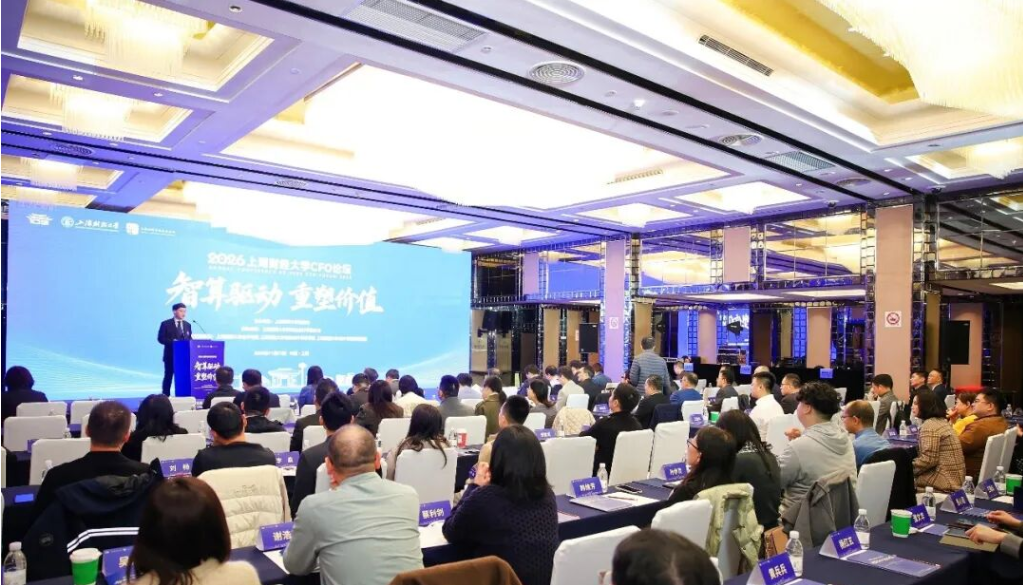
On 21 November, the 2026 Shanghai University of Finance and Economics (SUFE) CFO Forum was held in Shanghai. The forum was organised by the SUFE Alumni Association, hosted by the Accounting School Branch of the SUFE Alumni Association, and received academic support from the SUFE School of Accounting, the Advanced Institute of Accounting and Auditing, and the Institute of Accounting and Finance. With the theme 'Intelligence-Driven Transformation: Reshaping Value', the forum invited elite professionals and expert representatives from across the country to discuss the reshaping of financial value in the age of artificial intelligence, and how Chief Financial Officers (CFOs) can transition finance from being a 'recorder' of business to a 'co-creator' of value.
The forum was attended by Liu Yuanchun, President of SUFE; Chen Xinyuan, Dean of the Advanced Institute of Accounting and Auditing; Wu Jianhui, Director of the Management Committee of Dahua Certified Public Accountants, SUFE Council Member, and Chair of the Accounting School Branch of the SUFE Alumni Association, among other distinguished guests. The event attracted widespread attention from society, with over 150 guests in attendance, including alumni representatives from across the country, as well as representatives from well-known enterprises and institutions. The forum was chaired by Jin Qinglu, Dean of the SUFE School of Accounting.

In his speech, Liu Yuanchun extended a warm welcome to the alumni and guests present, and expressed sincere gratitude to all sectors of society that have long cared for and supported the development of the university, as well as to all parties involved in the preparation of the forum. He noted that as a pioneer in China’s higher education in finance and economics, SUFE has developed distinct financial characteristics and strengths in CFO talent cultivation over its century-long history. Since the inaugural forum in 2023, the university has continuously built a platform for the exchange of ideas among CFOs, bringing together industry wisdom to explore issues of financial transformation. He mentioned that 2026 marks the beginning of the 15th Five-Year Plan period and a crucial turning point where intelligent computing power shifts from scale competition to efficiency competition. With the theme 'Intelligence-Driven Transformation: Reshaping Value', this forum resonates with the pulse of the times. He also introduced that over the past year, SUFE has driven forward in a coordinated manner on disciplinary restructuring, platform advancement, and educational reform under the guidance of 'Digital-Intelligent New Finance'. Looking ahead, SUFE is willing to use the forum as a bond to join hands with financial and intellectual forces from all sectors, contributing new SUFE strength to national development and the rejuvenation of the Chinese nation.

Liu Yuan Chun delivered a keynote report titled 'Artificial Intelligence and Economic Growth from an Economic Perspective'. He systematically reviewed the theoretical challenges and practical debates brought about by artificial intelligence from an economic standpoint. He pointed out that this round of AI technological revolution represents a breakthrough in the extension of human intellectual boundaries. Currently, AI technology is widely applied in micro-level enterprises, yet macro total factor productivity has not improved correspondingly. Regarding the controversy over an AI bubble, he stated that the macroeconomic transmission of technological progress is subject to lags, accompanied in the short term by the restructuring of traditional resource allocation. Against the backdrop of the accelerating emergence of a new AI-driven economic paradigm, it is necessary to rationally assess the short-term pains; while actively embracing the changes, risks must be prudently managed. He emphasised that the economics community has its own specific paradigms for understanding AI, which can provide insights for making rational judgments on investment behaviour and strategic choices. At the same time, it must also be recognised that AI is a completely new phenomenon, and using traditional tools to study it may easily lead to 'carving a boat to find a sword'-type biases. Therefore, it is essential to adhere to the direction of a 'digital-intelligent new finance', and truly study the new laws of resource allocation in the digital era.

Chen Yi, Vice Chairman of KPMG China and Managing Partner for East China and West China, delivered a keynote report titled 'Strategic Choices for Professional Service Organisations in the AI Era'. He pointed out that AI is not merely a tool for improving efficiency, but a key factor driving industry transformation. Professional organisations should, based on industry trends and client needs, strengthen their capabilities in risk identification and decision support, thereby forming competitive advantages. Taking auditing as an example, he explained that AI can assist in transaction screening and anomaly detection; however, in more in-depth applications such as full-volume screening, the industry is still actively exploring. In critical areas such as complex transactions, fraud detection, and going concern assessments, professional judgement grounded in an understanding of the business remains essential for evaluating evidence and making independent decisions. He stated that the development of AI-based business platforms should properly manage the relationship between humans and machines, and uphold the four lines of defence: 'human review, human boundary-setting, human choice, and human accountability'. He emphasised that in the face of the AI wave, professional organisations should embrace it proactively while thinking prudently, 'The tide determines how far we sail, but the rudder determines our direction.'

Wei Xudong, Chief Financial Officer of Shanghai Electric Group, delivered a keynote speech titled 'Building on Digital-Intelligent Foundations and Advancing Towards Innovation'. He stated that enterprises advancing digitalisation during the 15th Five-Year Plan period should focus on three main areas: digital industries, the digital transformation of industry, and digitalised management and control. These efforts should closely align with business needs, leveraging digital technologies to enhance industrial competitiveness. He noted that the foundation of digitalised management and control lies in data governance, which can be advanced with the goals of 'penetration, visibility, connectivity, and intelligence', and that technologies such as artificial intelligence can be employed to assist in data analysis, risk early warning, and operational decision-making. He emphasised that financial digital transformation is a profound reshaping of management, requiring the coordinated governance of both business and data. At the same time, finance professionals must remain committed to their original aspirations of being accountable for data, serving business needs, and maintaining a strong awareness of risk, so as to better support strategic decision-making, risk management, and high-quality corporate development.

Chen Xinyuan, Dean of the School of Advanced Accounting and Auditing at Shanghai University of Finance and Economics, delivered a keynote speech titled 'The Impact of Corporate Organisational Change in the AI Era on CFOs'. He pointed out that technological changes drive simultaneous shifts in corporate strategy, organisational structure, and incentive mechanisms, thereby reshaping the role of the CFO. He believes that in the digital-intelligent era, enterprises need to rethink their strategic choices, and he illustrated different directions of strategic selection with multiple practical cases. He observed that as enterprises apply AI, their organisational structures are becoming increasingly flat, and some decision-making powers may be recentralised at headquarters, thereby improving operational performance. As a result, CFOs need to change how they obtain information, allocate resources, and evaluate value. He stressed that the financial leadership of CFOs in the AI era should include capabilities in strategic insight, data-driven decision-making, and organisational guidance, taking the lead in the company’s digital strategy, guiding business with value, and achieving a shift from merely 'being able to calculate' to 'understanding business, data, technology, governance, and rules'.

The roundtable discussion session was chaired by Huang Yanming, Director of the Research Institute and General Manager of the Institutional Client Headquarters at Orient Securities. Participants included Cao Jingnan, Assistant Director of the Research Institute and Director of the Policy and Economic Research Institute at Orient Securities; Qiu Zuxue, Executive Deputy General Manager of the Research Institute and Chief Analyst for the Metals Industry at Guolian Minsheng Securities; Shu Di, Head of the Technology Group at the Research Institute and Chief Analyst for Communications and Semiconductors at Orient Securities; and Li Yao, Head of the Consumer Group at the Research Institute and Chief Analyst for Food and Beverages at Orient Securities. The session, themed 'Top Analysts on the Future – Global Political Landscape in 2027 and Investment Outlook for the A-Share Market', featured in-depth discussions between the chair and the four guests on the global political landscape, industrial trends, and investment prospects in the capital market. From a professional perspective, they interpreted changes in the international situation as well as cycles in the technology and consumer industries, and shared insights on strategic choices for enterprises in the context of new globalisation.

Jin Qinglu delivered the concluding remarks. He expressed his heartfelt gratitude to the industry leaders, experts and scholars, guests from all walks of life, and alumni who attended the forum. He noted that since the inaugural CFO Forum was launched in 2023, the themes of the four editions have been closely interconnected, reflecting the insight and sense of responsibility of SUFE members in response to the changes of the times. With the theme 'Digital-Intelligent Driven, Reshaping Value', this edition builds on previous successes and looks to the future, focusing on the reshaping of financial value in the digital-intelligent era. It conducted in-depth discussions on macro trends, strategic choices of institutions, digital-intelligent transformation of manufacturing enterprises, organisational change and the capabilities of CFOs, as well as the outlook for the capital market in 2027, pooling industry wisdom and broadening cutting-edge perspectives. He emphasised that SUFE will continue to leverage the bridging role of the CFO Forum, further deepening university-local collaboration, university-enterprise cooperation, and alumni engagement, contributing 'SUFE wisdom' and 'SUFE strength' to the high-quality development of the national economy.