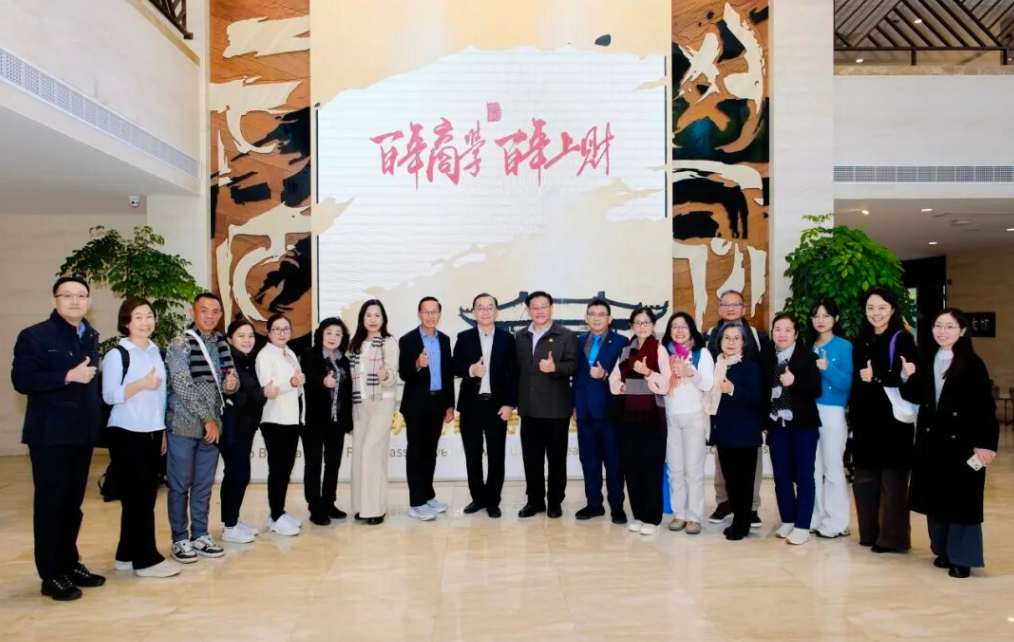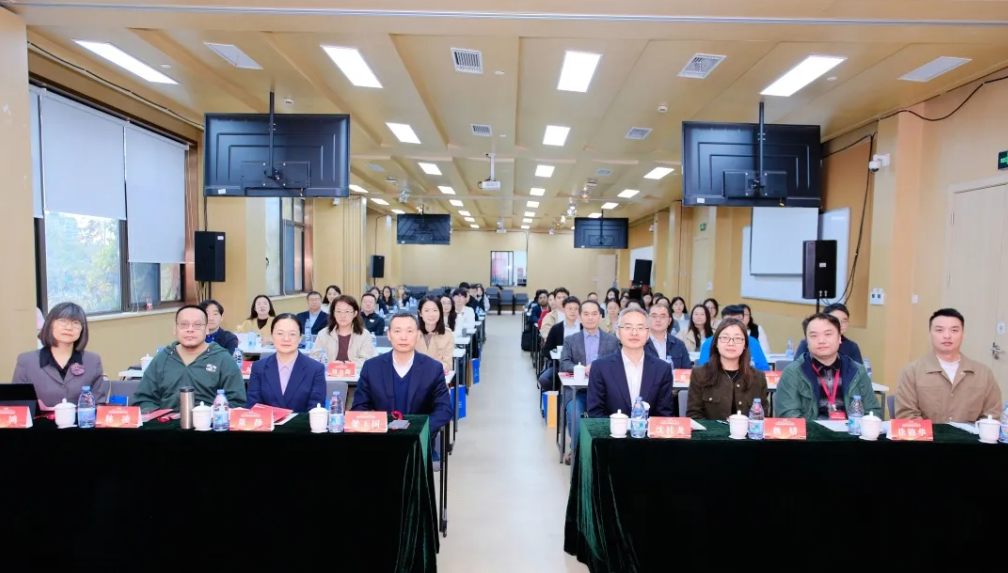
On 8 November, the First Doctoral Forum on World China Studies was successfully held in Shanghai. Under the theme "Research on and Talent Cultivation in World China Studies under the Autonomous Knowledge System", the forum aimed to further advance the cultivation of talent and the disciplinary development of world China studies. It formed part of the programme of the 20th (2026) Academic Activity Month of the Shanghai Federation of Social Sciences Associations.
The opening ceremony was presided over by Yang Hong, Secretary of the CPC Committee of the College of International Cultural Exchange, Shanghai University of Finance and Economics.
Liang Yuguo, Director of the Society Administration Division of the Shanghai Federation of Social Sciences Associations, and Dong Jing, Dean of the College of International Cultural Exchange of Shanghai University of Finance and Economics, delivered addresses respectively.
Liang Yuguo spoke highly of the positive contributions made by the Shanghai World China Studies Research Association to building the autonomous knowledge system of world China studies and promoting exchanges and mutual learning among civilisations. He encouraged young scholars to maintain theoretical ambition and scholarly patience before the great proposition of the autonomous knowledge system, and to integrate their personal academic pursuits into the overall development of the country.
Dong Jing noted that the international community pays close attention to the development of the Chinese economy and its impact on the world, and that economic and financial topics are an important component of China studies. She expressed the hope that more scholars would integrate the global vision of China studies with the practical orientation of the economics and finance disciplines, helping the world understand China through real business practice and fieldwork in society.
In the keynote session, five experts and scholars presented academic reports on the frontiers and hot topics of world China studies.
Shen Guilong, Research Professor and Director of the Institute of World China Studies of the Shanghai Academy of Social Sciences, Vice Chairman of the Shanghai Federation of Social Sciences Associations, President of the Shanghai World China Studies Research Association and Editor-in-Chief of China Studies (Chinese and English), spoke on "The Shifting Centre of China Studies from an Area-Studies Perspective". Tracing the evolution from European sinology and American China studies to world China studies, he pointed out that the centre of China studies is shifting away from Western centrality towards a plurality of subjects and the reconstruction of knowledge relations, and stressed that more Chinese subjects need to be brought into world China studies in order to advance the building of an autonomous knowledge system and the development of the field as an organised, systematic discipline.
Xu Jinhua, Associate Research Librarian and Deputy Director of the Historical Documents Centre of the Shanghai Library, spoke on "China Studies Collections and Shanghai". He observed that sinology in overseas Chinese communities has a dual character, being both an academic achievement and a cultural apparatus, and proposed promoting the empirical deepening of China studies and mutual learning among civilisations through the collation and publication of documents.
Zhu Shuran, Associate Professor and Executive Director of the MTI Education Centre of the School of Foreign Languages, Shanghai University of Finance and Economics, spoke on "Daoist Philosophy in the Global South". She revealed four forms of new life through which Chinese classics have been re-encoded in local contexts overseas, and advocated expanding the cross-disciplinary study of China studies and area studies from a Global South perspective.
Lin Ling, Associate Research Fellow of the China Institute of Fudan University and Deputy Editor-in-Chief and Director of the Editorial Office of Oriental Journal, spoke on "China's Building of an Autonomous Knowledge System and the World's 'Crossing the River by Feeling for Chinese Stones'". He argued that research on world China studies must proceed from practice, internalising the problems of developed countries and those of the Global South as problems of China studies itself.
Zhou Yang, Associate Professor and Head of the Department of Business Chinese of the College of International Cultural Exchange, Shanghai University of Finance and Economics, spoke on "The Case for Economics-and-Finance-Oriented China Studies". Noting that economics and finance are a central thread through which the world understands China, he suggested taking them as an entry point to promote academic and policy dialogue between China and other countries and to integrate economics-and-finance-oriented China studies into the education of international students.
The forum featured four parallel sessions devoted respectively to the themes "Building the Autonomous Knowledge System of World China Studies and Cultivating International Talent", "International Perceptions and Interpretations of Chinese-Style Modernisation", "The Cross-Fertilisation of World China Studies and Area Studies", and "The International Communication of Chinese Culture and Comparative Studies of Chinese and Foreign Civilisations". Experts from the Shanghai Academy of Social Sciences, Fudan University, the Shanghai Library and other universities and institutions commented on the presentations.
The closing ceremony was presided over by Rong Jun, Vice Dean of the College of International Cultural Exchange, Shanghai University of Finance and Economics.
Li Xuping, Professor and Deputy Director of the China Studies Centre of Zhejiang University, delivered the closing lecture entitled "The Zhejiang Paradigm of the Professional Master's Degree in China Studies: Cultivating 'China Competence'". Sharing the experience of advancing the localised development of the China studies programme at Zhejiang University drawing on the province's locational advantages, he proposed that the professional master's degree in China studies should highlight the cultivation of "China competence", building a training system that encompasses language and intercultural competence together with interdisciplinary knowledge of China and the capacity for practical action.
Zhang Xin, Associate Research Fellow of the Institute of World China Studies of the Shanghai Academy of Social Sciences and Secretary-General of the Shanghai World China Studies Research Association, gave the closing summary. In his view, the forum displayed a clear global vision along with distinctive features of intellectual mutual learning, disciplinary integration and frontier exploration, and young scholars are expected to become an important driving force in renewing the paradigm of China studies.
In the view of the participating experts, the forum further rallied the young strength of the field of world China studies, gave greater depth and solidity to the building of an autonomous knowledge system and the cultivation of talent, and injected new momentum into the development of world China studies as an organised, systematic discipline.
The forum was hosted by the Shanghai World China Studies Research Association and Shanghai University of Finance and Economics, and organised by the College of International Cultural Exchange of Shanghai University of Finance and Economics, the Center for "Chinese + Digital Economy" Studies of the Center for Language Education and Cooperation of the Ministry of Education and Shanghai University of Finance and Economics, and the Institute of World China Studies of the Shanghai Academy of Social Sciences, with the editorial office of China Studies (Chinese and English) as a cooperating partner. Nearly 100 participants attended, including experts, scholars, doctoral students and young sinologists from domestic universities and research institutions working in world China studies and related fields.